
turning diamonds
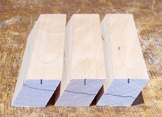
Much of my work results from a technique I call turning diamonds, referring to the shape of the wood pieces I use. Manipulating the pieces through a series of steps enables the creation of works on the lathe that take advantage of relationships among the multiple elements.
Brass plate engraving, Iran, 10 -11th century. Extensive development of the basic circle pattern can produce elaborate two- dimensional designs. Note how many variations in the design appear in patterns of six. (British Museum)
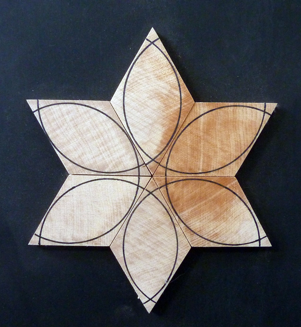
Six diamonds pattern. The black lines represent circular cuts on the lathe. If you continue them all around to make circles, you have something very similar to the Islamic seven-circle pattern.
Look Inside
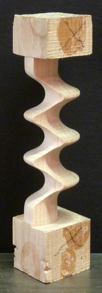
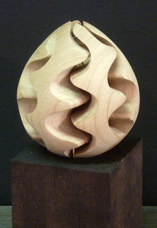
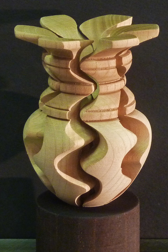
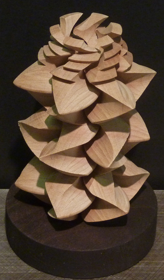
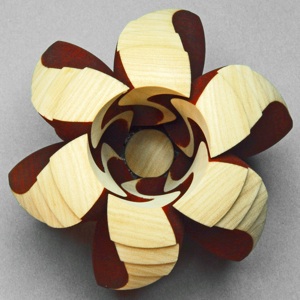
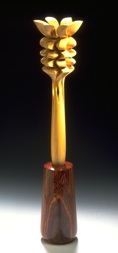
Turning diamonds produces overlapping shapes that create patterns on the open interior. These can be left alone as in the Boxwood Spray on the left, or worked further to reveal other shapes, as in Jiggy Ray Torchere on the right.
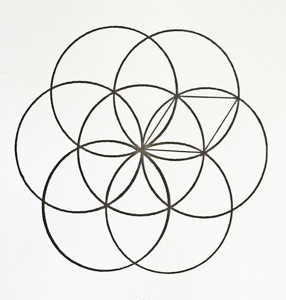
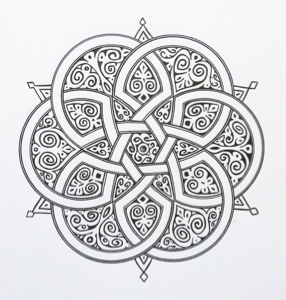
Islamic seven-circles pattern. Diamonds can
be drawn, as shown, by connecting intersecting arcs. Six circles arranged around the seventh enables the drawing of six diamonds meeting in the center.
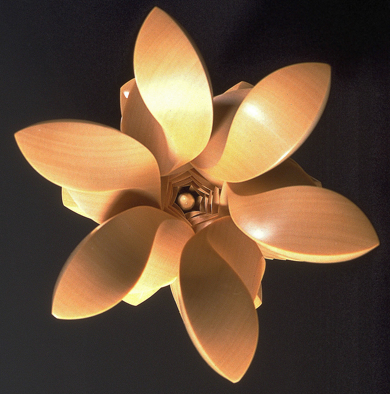
Shaping from two sides sets up a base pattern, in this case a simple series of offset coves and peaks.
When multiple elements are brought together, contours overlap. Shaping on the exterior reveals form available within the base pattern and repeats it. Here a teardrop shape emphasizes the profile of contours in the base pattern.
The basic idea
More varied shaping reveals other possibilities. The peak in this pattern can be used to suggest a cinched neck pulling in, as well as a blossom opening and pushing out. In the bowl, a vapor plume appears to rise between elements.
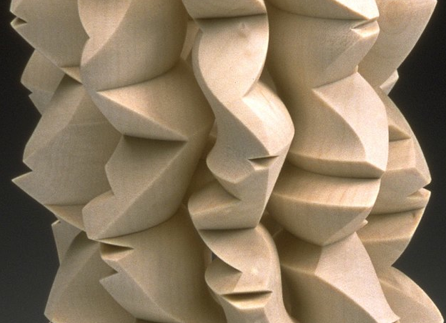
Exterior patterns can be developed. Here the placement of cuts creates patterns of facets that reverse orientation on each level. There is a hint of stretched fabric in this treatment.
Three variations from the same base pattern
Similar geometry
to Islamic circle designs
Working diamond shapes on the lathe applies circular cuts to the diamonds. When six diamonds are brought together, the circular cuts create a geometry similar to ancient Islamic seven-circle patterns. The Islamic designs start with circles from which diamonds can be formed (right). Turning diamonds starts with diamonds from which circles can be made (below). There is a significant difference in the two techniques, however. Islamic artists created works that spread across surfaces in two dimensions. Working on the lathe, I have been able to develop works in three dimensions.
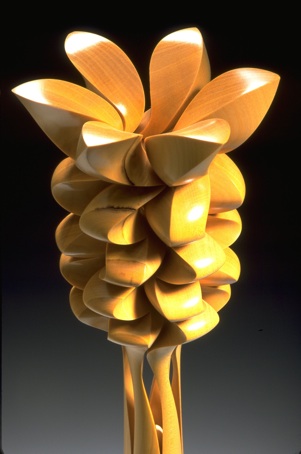
Boxwood Spray detail. Three-dimensional development of the seven-circle geometry. More patterns can be seen from the top view (scroll above to Look Inside).
Boxwood Spray
The idea further
Carried over many steps, complex relationships of form and pattern can be developed throughout the work.
I am grateful to the Metropolitan Museum of Art for their publication Islamic Art and Geometric Design, and to author Eva Wilson, the British Museum and Dover Publications for the book Islamic Designs.
Shot Tower detail
^^^